In2-MeC
newly discovered entries of In2-DeepFreeze First Generation Animations

 |
|
|
Kolhapur, Maharastra
25 January 2003
Cc Adi 4. 130
yaha haite sunirmala dvitiya nahi ara
tathapi sarvada vamya-vakra-vyavahara
TRANSLATION
Nothing is purer than Her love. But its behavior is always perverse and crooked.
* * * * * * * * * * * * * * *
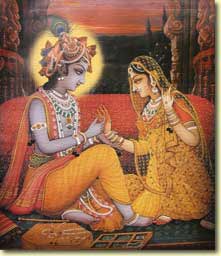
Every day in Goloka Vrndavana, Mother Yashoda writes a letter that is delivered to Yavat for Srimati Radharani. The letter invites Her to cook Lord Krsna's breakfast. Though Mother Yashoda loves Srimati Radharani with the combined tenderness of a million mothers, she is not aware of the secret intimacy between Sri Radha and her divine son Sri Krsna. All she knows is that Radharani was blessed by Sage Durvasa that whatever She cooks will taste like nectar; and that each time She cooks, the dishes She prepares will be different from all that She has ever cooked before. Yashoda simply wants the best for Krsna.
In obedience to Mother Yashoda, and in great eagerness to serve Her Lord, Radhika comes to Nanda Bhavan with all Her sakhis. By that time Yashoda has readied the kitchen--the stoves are fired and the ingredients are set out. The sakhis get busy, expertly cutting up different items, grinding and blending spices, combining ingredients. While Srimati Radharani cooks, Lord Krsna peeks at Her beauty from a hidden place.
Mother Yashoda, assisted by the sakhis, takes charge of serving Sri Krsna and His boy friends. Yashoda's intention is to take the remnants of her divine son. But after the Lord and the gopas have finished breakfast and before Yashoda is free to sit down for prasadam, the sakhis hurriedly remove every grain of remnants from Krsna's plate while strewing upon it remnants from the other plates. Krsna's remnants are smuggled out of the house to Srimati Radharani, who waits at a secluded spot on the road. In this way, even Yashoda-devi is transcendentally tricked by the crooked ways of Radhika and Her girlfriends.
In all such affairs, Srimati Radharani is sharply vigilant against discovery. She has to be so careful, especially since Her mother-in-law Jatila is extremely suspicious of Her. For example, once Jatila was dressing and decorating herself with the help of her transcendental daughter-in-law. Jatila couldn't find the kohl (eyeliner), which she was in the habit of calling "krsna" because of its black color. "Where is the krsna?" she asked Srimati Radharani.
Immediately, symptoms of ecstasy manifested in Srimati Radharani's person. Her hairs stood on end and She trembled all over. Jatila glared at Her. "What is this? I say 'krsna' and you are stunned? Why? What are You thinking about? WHO are you thinking about?"
The spiritual master represents Srimati Radharani. Therefore his ways are also crooked, while at the same time remaining ever pure.
* * * * * * * * * * * * * * *
London, 26 July 1976
George Harrison: He had a baby girl and was trying to think of a name, so I told him to call it Dhara, you know? `Cause from Radha--radharadharadha--it becomes dhara. So he called his girl that name.
Jayatirtha: There's a story of Valmiki, you know that story?
Gurudasa: Maramaramaramaramaramara.
Jayatirtha: Valmiki was a murderer, or a dacoit, thief. So he was met by Narada Muni, I think.
Prabhupada: Yes, Valmiki.
Jayatirtha: And he was advised by Narada Muni to please chant the holy name of the Lord and give up this thievery. So he wouldn't. So instead Narada Muni said, "You chant mara. " Mara means death. So he agreed.
Prabhupada: Maramara, rama.
Jayatirtha: Later on, this Valmiki, he wrote the Ramayana after having chanted rama, mara, he became purified.
Hari-sauri: Transcendental trickery.
Jayatirtha: All glories to Srila Prabhupada.
* * * * * * * * * * * * * * *
A Godbrother remembers Srila Prabhupada asking some disciples, "So, Krsna's devotee, is he simple, or is he crooked?" The devotees didn't quite know what to say, so Srila Prabhupada repeated the question. "Krsna's devotee, is he simple or crooked?"
Someone replied, "He is simple, Srila Prabhupada. "
"You think so? You are sure?"
"Yes, Srila Prabhupada. He is simple. "
"No, he is crooked. Just like me. I have tricked you all to take this Krsna consciousness. "
* * * * * * * * * * * * * * *
In just that way, Kasyapa Muni tricked his wife Diti, mother of the demons.
After her twin sons Hiranyaksa and Hiranyakasipu were killed by the Supreme Lord in His incarnations of Varahadeva and Narsimhadeva, she swore vengeance on Indra, the king of heaven. It was Indra, she reasoned, who instigated the Lord to descend and take action against her sons. So now she wanted a son who would be immortal like the demigods and yet would be the enemy of the demigods and the death of Indra.
For a long time she served her husband Kasyapa with great humility, care and attention, foregoing all personal comforts. Finally in gratitude he declared, "My dear wife, I am so pleased with you that I shall grant you whatever boon is within my power to give. "
On his word as a brahmana, Diti revealed her mind. He was shocked, but she was adamant: "I want a son from you who is an immortal enemy of the immortals, and who will kill Indra, the king of the immortals. "
Kasyapa seemed to relent. He told his wife that she could get such a son only if she performed an austere ritual called Pumsavana strictly for one year. If she deviated from the rite in the slightest way during that period, she would get a son who would be friendly to Indra. She promised to follow the Pumsavana vow in every detail.
At the core of the rite was the worship of Sri Sri Lakshmi-Narayana. Thus the Pumsavana vrata was really pure devotional service disguised by Kasyapa Muni to look like a method of religion that only a demon would follow. When she set herself on the Pumsavana path, Indra came to serve her, claiming himself to be impressed by his aunt's spirituality. In truth his interest was to find a weakness in her practice so that he could kill her son while he was still in the womb.
During her execution of the vow, Diti became pregnant. When she was heavy with child, she could no longer tolerate the austerity, although she valiantly tried. One day she neglected to observe one of the rules of cleanliness. While she slept in an unclean state Indra assumed a tiny form and entered her womb. He cut the embryo into seven pieces. Each piece instantly became a separate whole embryo. The seven babies started to cry. Worried that their crying would awaken their mother, Indra told them, "Ma rodih" (don't cry), from which they got their name as the Maruts. He cut each new embryo into seven. Now there were forty-nine embryos. They requested Indra to stop hurting them. "We are demigods like you," they pleaded. "We are your friends, not your enemies. "
Indra came out of Diti's womb accompanied by the 49 Maruts. When she awoke, she saw her sons sharing friendly talks with Indra. Amazingly, she found herself pleased at this. Indra, seeing his aunt was awake, humbly begged her forgiveness for trying to do harm to her sons. She was surprised at herself for accepting his apology and for feeling kindness toward him.
She realized that her husband had tricked her. Instead of getting a son to satisfy her murderous desires, her following of the Pumsavana rite had purified her heart. The thought of killing Indra had left her. She had become a devotee. What's more, instead of one immortal son, she had forty-nine.
* * * * * * * * * * * * * * *
Syamasundara Prabhu told of a little-known event that I think is a true-life illustration of what Srila Prabhupada meant when he said that if the son asks the father to take him to the cinema and the father agrees, then that cinema-watching is not sinful. Syamasundara got a hot tip of a coming increase in the value of gold. He advised Srila Prabhupada of this money-making opportunity. The two of them flew to Zurich and bought gold at the Swiss Credit Bank for $20 000. They waited a week as the gold price climbed. Finally Srila Prabhupada got bored and they sold their gold, doubling their investment.
Well. The vow not to gamble or speculate rules out just this kind of activity. It's sinful. But Syamasundara Prabhu, Prabhupada's spiritual son, asked if his transcendental father would like to take a chance on the gold market. Prabhupada agreed. Though it was gambling, it was not sinful.
* * * * * * * * * * * * * * *
Big Bertha from Berlin is rather outraged by all this. She argues that Srila Prabhupada's perfection is a spiritual fact. But since Bhagavad-gita says all endeavors in the material world are covered by fault, it is misleading to say that everything Prabhupada did in his life here was perfect. It was not right for him to encourage a disciple to gamble like that. His instructions to his disciples about gurukula were not perfect either. In fact, despite what was written earlier in In2-MeC about Lord Ramachandra, He too was not a completely ideal example. He sent His wife away to the forest while she was pregnant. This encourages ordinary male devotees to abandon their wives. We've seen too much of this sort of thing in ISKCON.
* * * * * * * * * * * * * * *
For the neophyte especially, considering a pure devotee from a material point of view is very injurious. One should therefore avoid observing a pure devotee externally, but should try to see the internal features and understand how he is engaged in the transcendental loving service of the Lord. In this way one can avoid seeing the pure devotee from a material point of view, and thus one can gradually become a purified devotee himself.
When one thus criticizes a pure devotee, he commits an offense (vaisnava-aparadha) that is very obstructive and dangerous for those who desire to advance in Krsna consciousness. A person cannot derive any spiritual benefit when he offends the lotus feet of a Vaisnava.
--Nectar of Instruction
text 6, purport
* * * * * * * * * * * * * * *
Cc Madhya 6. 196
bhagavan, tanra sakti, tanra guna-gana
acintya prabhava tinera na yaya kathana
TRANSLATION
Sri Caitanya Mahaprabhu said: The Supreme Personality of Godhead, His different potencies and His transcendental qualities all have inconceivable prowess. It is not possible to explain them fully.
Cc Madhya 23. 39
yanra citte krsna-prema karaye udaya
tanra vakya kriya mudra vijneha na bhujhaya
TRANSLATION
Even the most learned man cannot understand the words, activities and symptoms of a person in love of Godhead.
 |
|
|